
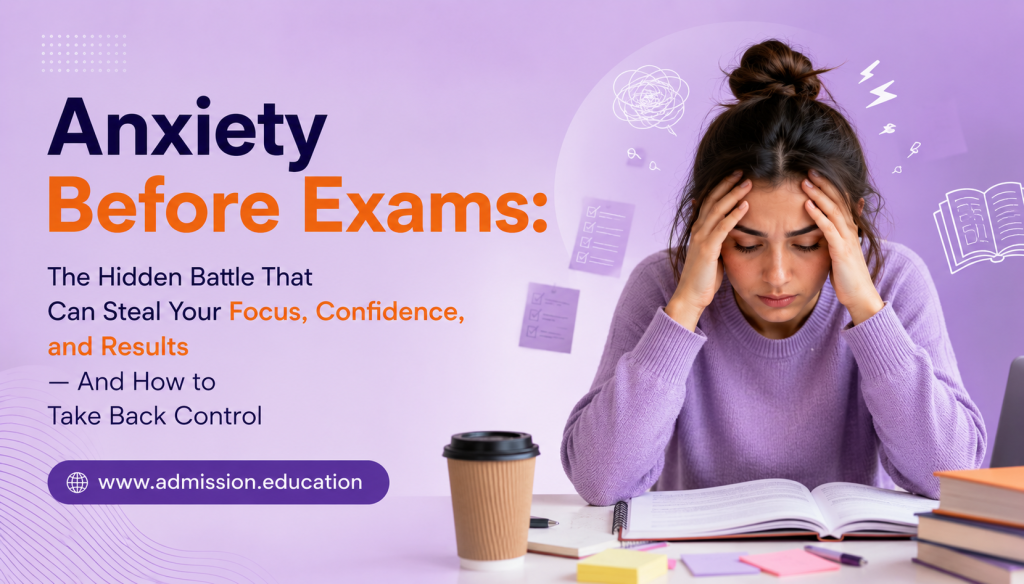
Exams are supposed to measure what you have learned, but for millions of students, the real challenge begins before the question paper even reaches their hands. Anxiety before exams can turn preparation into panic, confidence into self-doubt, and a normal test into something that feels overwhelming. Your heart may race, your thoughts may become scattered, and suddenly everything you studied seems to disappear. But feeling anxious does not mean you are incapable. It means your mind and body are reacting to pressure, uncertainty, and expectations. Understanding what is happening is the first step toward changing it.
Why does anxiety become so powerful before an exam? Often, it is not the examination itself but what the student believes the examination represents. Fear of failure, disappointing parents, losing an opportunity, comparing yourself with classmates, or believing that one result will determine your entire future can create enormous emotional pressure. When these thoughts repeat constantly, the exam becomes bigger in your mind than it actually is. The urgent question is not whether you can eliminate every anxious thought, but whether you can stop those thoughts from controlling your preparation.
One of the most damaging patterns is waiting until anxiety disappears before starting to study. Unfortunately, avoidance often makes anxiety stronger. The longer you postpone revision, the more frightening the unfinished work appears. Instead of trying to complete everything in one exhausting session, divide your preparation into smaller, realistic targets. Choose one chapter, one topic, or one set of questions and focus on completing that task. Progress creates evidence that you are moving forward, and that evidence can gradually weaken the feeling that everything is out of control.
Your study environment also matters more than you may realize. Constant notifications, social media scrolling, unnecessary multitasking, and studying in a chaotic environment can make concentration much harder. Create a simple study routine with clearly defined periods for focused work and breaks. Keep your immediate goal visible and remove distractions that repeatedly pull your attention away. You do not need a perfect study schedule; you need a routine you can actually follow. Consistency will usually take you further than an unrealistic timetable that collapses after two days.
Another powerful strategy is to replace passive studying with active recall and practice. Reading the same chapter repeatedly can create the comforting feeling that you know the material, but testing yourself reveals what you genuinely remember. Close the book and explain a concept in your own words. Attempt practice questions without looking at the answers. Review mistakes instead of hiding from them. Every mistake you identify before the examination is an opportunity to improve before it matters. Preparation becomes much less frightening when you can see exactly what you know and what still needs attention.
Physical symptoms can make exam anxiety feel even more frightening. A racing heart, tense muscles, shaky hands, sweating, stomach discomfort, or difficulty concentrating may cause you to think that something is seriously wrong. In many situations, these are signs that your body’s stress response has been activated. Slow, controlled breathing can help you pause rather than immediately react to the sensation. Try breathing gently and slowly while relaxing your shoulders and allowing your attention to return to the present moment. If anxiety symptoms are severe, persistent, or interfering significantly with daily life, speaking with a qualified healthcare or mental health professional is an important step.
Sleep is another area students often sacrifice when exams approach, believing that another few hours of studying will guarantee better results. Running on exhaustion can make concentration, memory, decision-making, and emotional control more difficult. Instead of treating sleep as wasted study time, treat it as part of preparation. A rested brain is better positioned to process information and perform under pressure. The night before an important examination is rarely the ideal time to learn an entire syllabus from scratch. Prepare earlier, wind down when possible, and give your mind an opportunity to recover.
The language you use with yourself can also influence how you experience exam pressure. Telling yourself, “If I fail, everything is over,” creates an impossible standard. A more balanced thought might be, “This exam matters to me, and I will prepare as well as I can, but one result does not define my entire ability or future.” This is not about pretending that failure does not matter. It is about refusing to turn one difficult outcome into a permanent judgment about yourself. Your performance deserves effort, but your self-worth should not depend entirely on a grade.
Parents, teachers, and friends can make a meaningful difference too. Students experiencing exam anxiety do not always need another lecture about working harder. Sometimes they need someone who will listen without immediately judging, comparing, or predicting failure. Asking a student, “What part of the exam is worrying you most?” can open a more useful conversation than simply saying, “You need to study more.” If you are supporting someone through exam stress, encourage realistic preparation, healthy routines, breaks, and professional support when anxiety becomes difficult to manage.
The most important change may be moving from fear-driven preparation to action-driven preparation. Do not spend hours imagining the worst possible result while doing nothing that could improve your position. Identify what remains to be studied. Prioritize the most important topics. Practice under realistic conditions. Review your mistakes. Sleep. Repeat. When anxiety appears, acknowledge it without allowing it to dictate your next decision. You do not have to feel completely confident before taking action. Sometimes confidence arrives after you begin.
Exam anxiety deserves to be taken seriously, but it does not deserve to convince you that you are powerless. You are more than one examination, one grade, one mistake, or one difficult academic season. Start preparing before panic forces you to. Replace endless worrying with one useful action at a time. If anxiety becomes overwhelming, persistent, causes major disruption, or feels impossible to manage on your own, reach out to a qualified professional, school counselor, or trusted adult. The goal is not to become a student who never feels nervous. The goal is to become someone who can feel pressure and still move forward. Your next step does not need to be perfect. It simply needs to begin.