
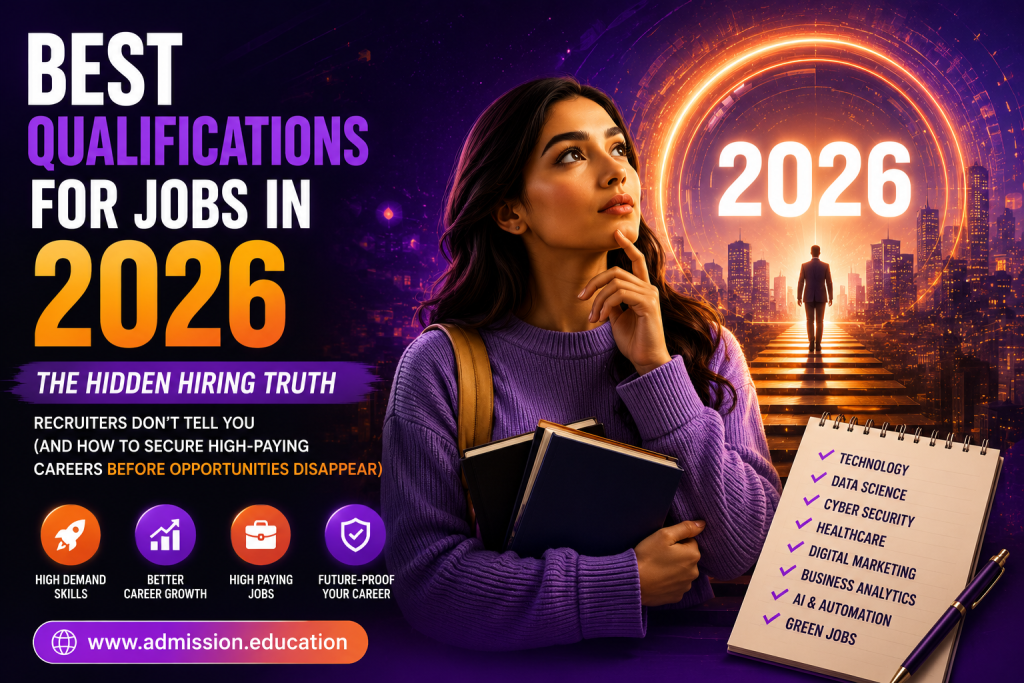
Best Qualifications for Jobs in 2026: The Hidden Hiring Truth Recruiters Don’t Tell You
Introduction: A Job Market That Has Already Changed
The world of employment is no longer what it used to be. Degrees alone are no longer a guarantee of success, and experience without direction often gets overlooked. In 2026, employers are not just hiring qualifications; they are hiring relevance, adaptability, and proof of real-world capability.
This shift is silent but powerful. Those who understand it early will secure the best positions, while others may continue applying with outdated expectations and miss life-changing opportunities.
The real question is no longer “What degree do you have?” but rather “What can you actually do in a rapidly changing world?”
Why Traditional Qualifications Are No Longer Enough
For decades, a degree was considered the golden ticket. Today, that ticket has changed its shape.
Employers now evaluate candidates based on:
- Practical skill application over theoretical knowledge
- Digital and technological adaptability
- Problem-solving ability in real-time environments
- Communication and decision-making strength
- Industry-specific certifications and micro-credentials
The hiring system has shifted from education-first to skill-first evaluation.
If your qualifications are not aligned with industry demand, you are already at a disadvantage.
The Best Qualifications for Jobs in 2026
1. Industry-Relevant Degree Programs
Degrees still matter, but only when aligned with demand-driven sectors.
High-value fields include:
- Data Science and Artificial Intelligence
- Cybersecurity and Information Systems
- Healthcare and Biotechnology
- Digital Marketing and E-Commerce
- Engineering and Automation Systems
A degree alone is not enough; specialization is the real advantage.
2. Professional Certifications That Outrank Degrees
In many industries, certifications now carry more weight than traditional education.
Examples include:
- Project Management certifications
- Cloud computing credentials
- Financial analysis and accounting certifications
- UX/UI and design certifications
- Digital strategy and marketing certifications
These qualifications signal job readiness, not just academic learning.
3. Digital Skills as Core Qualifications
Every job is becoming a digital job.
Essential digital competencies include:
- Data analysis and interpretation
- AI tool usage and automation understanding
- Software and platform literacy
- Online communication and collaboration tools
- Basic coding awareness
Without these, even strong academic qualifications may lose value.
4. Soft Skills That Define Career Growth
Technical knowledge opens the door, but soft skills decide how far you go.
Employers consistently prioritize:
- Critical thinking and adaptability
- Leadership and teamwork
- Emotional intelligence
- Time management and accountability
- Communication clarity
These skills often determine promotions and long-term success.
5. Experience-Based Learning (The Hidden Qualification)
Internships, freelance work, volunteering, and real-world projects now act as powerful qualifications.
Why?
Because they prove you can execute, not just learn.
Even short-term experience can outperform years of theoretical education if applied correctly.
The Hidden Truth Recruiters Rarely Say
Most employers are not searching for “perfect candidates.” They are searching for “ready candidates.”
A ready candidate:
- Can solve problems immediately
- Requires minimal training
- Adapts quickly to company systems
- Shows initiative without constant supervision
This is why many highly educated candidates are rejected, while less formally educated but skilled individuals get hired.
Urgency: Why You Must Act Now
The job market is becoming more competitive every year. Automation, AI, and global talent competition are reshaping hiring standards faster than traditional education systems can adapt.
If you delay upgrading your qualifications:
- You risk being underqualified in your own field
- You may face reduced job opportunities
- Salary growth may stagnate
- Career mobility becomes limited
The opportunity gap is widening, not shrinking.
Action Plan: How to Secure High-Value Jobs
To stay competitive, you must:
- Identify your target industry
- Match your skills with job market demand
- Earn at least one recognized certification
- Build real-world experience (projects or freelance work)
- Continuously upgrade digital skills
- Build a professional online presence
Consistency in these steps creates long-term career security.
Conclusion: Your Qualification Is Your Strategy, Not Just Your Certificate
In 2026, success is no longer about collecting degrees. It is about building a strategic combination of education, skills, certifications, and experience.
Those who understand this shift will not just find jobs—they will shape careers, industries, and financial futures.
The question is not whether opportunities exist.
The question is whether your qualifications make you visible to them.