
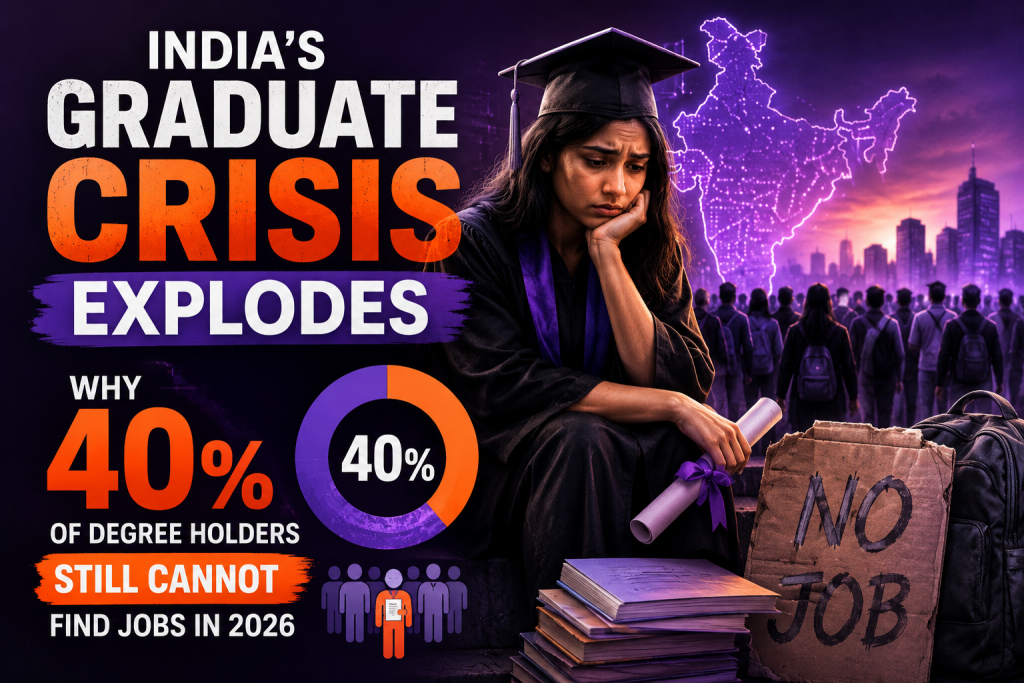
A nation of degrees, but not enough careers
India is producing millions of graduates every year, yet a shocking reality is now impossible to ignore: nearly 40 percent of graduates are struggling to find jobs. Behind every statistic is a young person carrying dreams, student debt, family expectations, and years of sacrifice only to face silence from recruiters, endless applications, and rejection emails that never stop coming.
This is no longer just an employment issue. It is becoming an economic, emotional, and social crisis that could redefine the future of India’s workforce.
For decades, education was marketed as the ultimate pathway to success. Parents invested life savings into schools, colleges, coaching centers, and university degrees believing that graduation guaranteed stability. But today, thousands of graduates are discovering a painful truth: having a degree is no longer enough.
The modern job market has changed faster than the education system could adapt.
Why are Indian graduates unable to secure jobs?
The problem is not a lack of intelligence or ambition. The deeper issue lies in the widening gap between academic learning and industry expectations.
Many companies now prioritize practical skills over theoretical education. Employers want graduates who can solve problems, communicate effectively, adapt quickly, and understand real-world business environments from day one.
Unfortunately, many universities still rely on outdated teaching models that focus heavily on memorization rather than innovation, digital literacy, or practical experience.
As industries evolve through artificial intelligence, automation, cybersecurity, digital marketing, data analytics, and advanced technology, many graduates are entering the workforce without the skills companies urgently need.
The result is devastating:
- Graduates remain unemployed for months or years
- Companies continue complaining about skill shortages
- Families face increasing financial pressure
- Young professionals lose confidence in their future
This contradiction is creating one of the biggest employment paradoxes in India’s history.
The emotional cost behind unemployment
Unemployment does not only affect finances. It affects identity, confidence, relationships, and mental wellbeing.
Many graduates spend years imagining their future careers only to feel trapped after completing their education. The emotional burden becomes even heavier when society equates unemployment with failure.
In countless households across India, graduates are silently battling anxiety and self-doubt while pretending everything is fine.
Parents who sacrificed everything for their children’s education often feel helpless. Students who once dreamed of independence begin questioning whether their hard work was worth it.
This crisis is creating frustration among an entire generation.
The dangerous rise of “degree inflation”
One major reason for this crisis is the growing phenomenon known as degree inflation.
Years ago, a bachelor’s degree was enough to stand out. Today, millions hold similar qualifications, making competition brutally intense. As more graduates enter the market, employers raise expectations even further.
Now candidates are expected to have:
- Certifications
- Internships
- Technical expertise
- Communication skills
- Portfolio experience
- Industry exposure
- Digital knowledge
- Networking ability
Many graduates complete university without access to these opportunities, especially those from smaller towns or financially struggling families.
The result is inequality within the job market itself.
Technology is reshaping hiring faster than education can react
Artificial intelligence and automation are transforming industries across the globe. Traditional entry-level jobs are disappearing while companies increasingly seek specialized talent.
Recruiters now use AI-powered systems to filter resumes before humans even see them. Candidates lacking optimized resumes, digital skills, or online portfolios are often rejected instantly.
This means graduates are no longer competing only with local candidates. They are competing in a global digital economy.
India’s education ecosystem must urgently evolve if students are expected to survive in this new employment landscape.
The industries still creating opportunities
Despite the crisis, opportunities still exist for graduates willing to adapt.
Industries showing strong growth include:
- Artificial intelligence
- Software development
- Healthcare technology
- Digital marketing
- Cybersecurity
- Renewable energy
- Content creation
- E-commerce
- Data science
- Financial technology
However, success in these sectors often requires continuous learning beyond traditional classroom education.
The graduates winning today are those willing to:
- Learn modern tools
- Build practical experience
- Create personal brands online
- Develop communication skills
- Adapt to fast-changing technologies
The future belongs to learners, not just degree holders.
India’s youth deserve better
India has one of the largest youth populations in the world. This should be a massive economic advantage. Instead, unemployment risks turning potential into frustration.
Young people are not asking for shortcuts. They are asking for opportunity, relevance, and a fair chance to build meaningful careers.
Educational institutions, policymakers, and industries must work together to bridge the growing divide between education and employability.
Without urgent reform, the nation risks creating millions of educated yet economically disconnected citizens.
What must change immediately
To solve the graduate unemployment crisis, several urgent changes are necessary:
Universities must modernize curriculum
Courses should align with real industry needs instead of outdated theoretical structures.
Practical training should become mandatory
Internships, live projects, and hands-on learning must become central to education.
Students must learn employability skills early
Communication, leadership, teamwork, and digital literacy are now essential.
Career guidance should improve
Many students graduate without understanding market demands or career pathways.
Companies should invest in fresh talent
Businesses must create training ecosystems instead of expecting perfect candidates immediately.
The future of work in India is changing forever
The world is entering a new economic era where adaptability matters more than traditional credentials.
Graduates who continue learning, upgrading skills, and embracing digital transformation will eventually create opportunities even in difficult conditions.
But the responsibility cannot fall entirely on students.
A country cannot thrive when educated youth feel invisible in their own economy.
India’s graduate unemployment crisis is more than a headline. It is a warning sign about the future of education, work, and economic growth.
The question is no longer whether change is needed.
The question is whether change will happen fast enough before another generation loses faith in the promise of education itself.